13 February, 2021

A Historical Look at the OSR — Part II

Dragon #22 - nothing to do with this article
In my previous post in this series I examined the evolution of the 1st edition-era adventure module, with a view to exploring how the design and play philosophy of old-school D&D moved away from its origins. While I plan on continuing to follow the adventure module into 2nd edition, for this post I want to primarily focus on rules.

While it might appear to be a no-brainer, I think an essential—and often overlooked—element of game design is asking the question, "what sort of gameplay does this rule actually create?".  The answer always trumps what the rules text actually says or the intention behind it, and is why so many apologist arguments based on "but that's not how it's supposed to be done!" fail to convince despite the empirical truth behind them.  When faced again and again with the natural outgrowth of a rule, at a certain point the logical response is to acknowledge that that's the reality, regardless of intention, and either reword the rule to better get what you originally intended, or acknowledge how it's actually being played in the wider environment and reinforce that.  I'll be returning to this point throughout the text.

Fanatical game hobbyists often express the opinion that DUNGEONS & DRAGONS will continue as an ever-expanding, always improving game system.  TSR and I see it a bit differently. … Americans have somehow come to equate change with improvement.  Somehow the school of continuing evolution has conceived that D&D can go on in a state of flux, each new version “new and improved!”  From a standpoint of sales, I beam broadly at the very thought of an unending string of new, improved, super, energized, versions of D&D being hyped to the loyal followers of the gaming hobby in general and role playing fantasy games in particular.  As a game designer I do not agree, particularly as a gamer who began with chess. … As all of the ADVANCED D&D system is not written yet, it is a bit early for prognostication, but I envision only minor expansions and some rules amending on a gradual, edition to edition, basis.  When you have a fine product, it is time to let well enough alone.  I do not believe that hobbyists and casual players should be continually barraged with new rules, new systems, and new drains on their purses.  Certainly there will be changes, for the game is not perfect; but I do not believe the game is so imperfect as to require constant improvement.

Gary Gygax, Dragon #22 (February 1979)

True to this pronouncement, once AD&D’s last core volume—the DMG—was released in August 1979, support for the game focused primarily on adventures, with the occasional other item such as DM shields, monster manuals, geomorphs, official beach towels, and so on.  It wasn’t until 1985, when TSR’s dire financial straits combined with Gygax’s accumulated backlog of Dragon magazine articles to produce Unearthed Arcana (UA), that we saw a major new rules supplement.  This sourcebook introduced a host of changes, mostly dubious, but while the material within it was perfectly capable of unbalancing campaigns,[1] it was not due to an alteration of the game's central design philosophy but because much of the material was poorly playtested.  In other words, most of UA is perfectly old school in tone, just bad.


The Decline of the Old School — Skill Systems


More relevant for our purposes than UA is the other hardback rules volume of 1985: Oriental Adventures (OA).  Following close on their heels was the 1986 duo of the Dungeoneer’s and Wilderness Survival Guides.  Collectively, the effect of the sudden appearance of these four new rules-laden hardbacks six years after the last official AD&D rules release, plus the marked drop-off in module quality in 1984 (typically exemplified by Dragonlance) and Dragon’s insistence that all material going forward would use the UA rules when relevant,[2] eventually led players to refer to this late period of 1st edition’s life as 1.5 edition (or 1.5e).[3]  A major element of this "new" quasi-edition was that the three non-UA books all fielded D&D’s first (non-thief) skill system: the non-weapon proficiency (NWP) rules.[4]
 
System-wide skill systems (as opposed to those associated with a single class, like skills for the thief, which debuted in 1975's Supplement I: Greyhawk) were an early game design innovation.  They first showed up in 1976 in FGU's Bunnies & Burrows game, but are better known to most through their implementation in Chaosium's popular BRP rules system, starting in 1978 with RuneQuest.  Skill systems have some core downsides.  They add more rules to the game, imposing a comprehension tax that makes it take longer to learn (and to leaf through the book during the game when you're in search of a rule).  And, as with any character option added, they make characters take longer to create, as players want to go through everything available and make informed choices.  All the same, there are numerous games that effectively utilize skills, and if done well skills can provide a useful means of differentiating characters and defining their capabilities: this is not an article claiming that there is no role in game design for skill systems.
 
But to understand why they matter from a specifically old-school perspective, it's important to realize that, when a player wanted to do most anything in the game prior to this point, they usually had to negotiate with the DM for how to do it: was it possible, if so what would it entail, how long would it take (for time was a vital currency in old-school play) and finally, how would it be resolved mechanically (e.g. roll 1D6, 2D6, 1D20; Gygax favoured percentile).  A player would a) in general have to describe what they were doing (even if often this was just a very brief description), and b) tend to leave things that were assumed to be outside their grasp to NPC specialists (“why would I know anything about alchemy?”).  Tasks were arbitrated on the fly by the DM, with those that came up often enough typically given answers that progressed to the status of house rule.  Each group could handle things in their own preferred fashion.  With skill lists, even if optional, players tend to look to these as the full and official implementations and want to use them in that fashion, greatly reducing the scope of rulings.
 
OD&D Vol. III p. 13.  Click to enlarge.
Skills also almost inevitably shift the playstyle to what one might call button-based gameplay.  Players no longer feel the need to describe what they’re doing, because the relevant skill check (or its kissing cousin, the attribute check) allows a shortcut.  To pick one example, every old-school ruleset back to OD&D had a basic X-in-1D6 roll search method for secret doors, but this existed side by side with a narrative (i.e. investigative) approach to actually finding the door that could entirely obviate the need for a roll
; see p. 13 of The Underworld & Wilderness Adventures and pp. 97 and 99 of the 1st edition DMG for a good example.  Both existed, and the DM could use either as desired.  As time went on, the roll aspect came further to the fore, while the narrative angle retreated to the background.  B/X was happy to run with a declaration of intent followed by a roll (pp. B21 and B60), as was Mentzer, largely ignoring the narrative element.  Eventually we wound up with a universal application of “I make a Search check”, with the narrative element abandoned entirely.[5]  This broad tendency is so powerful that even with there being a caveat right in the rules of “X roll shouldn’t take the place of roleplaying or logic”, you still have people just shortcutting to rolls, because people are naturally lazy.[6]  To return to the question I opened with, "what sort of gameplay does this rule create?"  Here we see a mechanic slowly but surely changing the face of play.

Good or bad effects on play by the concept aside (and there is certainly a school of thought even amongst old-school players that there's nothing wrong with just rolling for searches rather than wasting an enormous amount of playtime
pixelbitching your way across a room), this all assumes that the skill system was well constructed.  However, in these early days of RPG design, the pitfalls of these systems were easily missed, and mistakes were made.  There is a sort of cobra effect present in many skill systems, in that rules designed to increase variety and player options can actually wind up reducing them.  Before NWPs, a general principle of D&D might be termed “assume competence”: it was presumed that players could survive in the wilderness, ride a horse, start a fire, and other typical adventuring tasks.  Generally, there was a broad swath of everyman knowledge and abilities related to adventuring (the PC realm) and then everything else (alchemy, deep lore, crafting, etc), which tended to be shunted off to the NPC realm.
 
Under the Oriental Adventures rules, however, Fire Building and Survival became barbarian-only skills.  These weren’t exotic implementations, either: Fire Building allowed one to literally start a fire, with the natural follow-on assumption that if you did not have that skill, you couldn’t start a fire—otherwise, what’s the point of the skill?  For the general skill list, Cooking, Dancing, Fishing, Gaming, Horsemanship, Hunting, Small Water Craft, and Swimming were some of the skills listed.  Very few of these offered anything interesting (one was Horsemanship, which was not about mere riding but allowed a few interesting tricks).  Swimming was simply “the basics of swimming”; Cooking, Dancing, and Fishing were the same.  Small Water Craft allowed you to make a raft or row a boat, or hide them if needed, while Gaming let you cheat, abilities no DM would have previously ever imagined reserving to the specially trained.  Now, however, all of these were locked behind a skill wall, and sometimes a class wall on top of that.  While the occasional genuinely interesting (if niche) skill was presented, like Falconry or Tea Ceremony, broadly a system designed to increase PC competence wound up dropping it: the average OA character used more rules to be less capable than ever before.[7]
 

Of course, this was just for Oriental Adventures.  For non-OA AD&D campaigns, NWPs came into the ruleset via the Dungeoneer’s and Wilderness Survival Guides.  Each had a variant of the OA system, with more focus on the environment under consideration; each was expressly optional.  While these books are generally considered the nadir of 1st edition, to their credit the designers did correct some of the mistakes of OA.  There was a specific statement that "Under normal circumstances, there is no chance of failure involved when characters attempt to use most nonweapon proficiencies".  The NWP writeups reflected this.  For example, fire-building now allowed one to start a fire without flint or a tinderbox; if you had these, you started a fire twice as fast as normal, which is a clear advantage if you actually cared to time firestarting.  Boating, Foraging, Mountaineering, Hunting: all these skills were mostly worded so that you were better than the average person at these things, rather than being allowed to do them at all.  Nonetheless, a wider tendency developed that restricted anything interesting along these lines to holders of the relevant skill, leaving the everyday adventurer less capable than in pre-skill days.[8]  Again, another clash of intent versus actual play appears.

The Oriental Adventures implementation gave fixed chances of success based on the skill (e.g. all characters succeeded at Hunting on a base roll of 16 or less).  The major issue that ran across the Survival Guide implementations, by contrast, is that they were tied to attributes.  For 1st edition specifically, the classic "3D6 straight down the line" rolling method for generating attributes was noted in the DMG as suboptimal, and Method I (of the four suggested, which did not include 3D6) was 4D6, drop the lowest, arrange to taste.[9]  But even this improved method only produced an average result of 12.25.  A system based on attributes for the average PC thus only meant success a base 60% of the time.  Additionally, regardless of stats or modifiers in your favour, the Dungeoneer’s Guide had an automatic 15% chance of failure (any check result of 18-20 auto-failed, after consulting Dragon #118 for errata), while the Wilderness Guide had an automatic 10% (any check result of 19-20 auto-failed).  There were some selection pressures in favour of success that are not immediately obvious when you look over these systems, in that players will tend to pick the skills their character class makes them already inclined towards, and thanks to the assumption that you can arrange your stats to taste and then pick a character that best suits those, you’re liable to have a slightly better stat forming the basis of the skills you bothered taking.  But all the same, failure rates beyond the basic tasks that auto-succeeded tended to be rather high.  You could improve your chances by investing more slots into the same proficiency, but as slots were quite rare (about 3 to start, plus 1 more every 3-4 levels) and the improvement created by repeat investment small (two points), this was not a popular option.  Some NWPs had innate check bonuses (e.g. Healing was two points easier than average; Fungus Identification was six points easier), others negatives (Airborne Riding was ominously two points harder), and situational modifiers were encouraged, but either were just as likely to be negative as positive.

Outside the realm of the player character, skill systems can also have a major effect on adventure design.  When implemented intelligently they increase scenario complexity in entertaining ways, offering varying approaches to key problems.  When handled poorly, however, they can literally cripple an adventure.  The most common such design error is “roll to play”.  If the players don’t make their Etiquette skill check, the key NPC won’t help them; if they fail their Lockpicking roll, the door to the dungeon won’t open.  While some might find it hard to believe that anyone would write such a scenario, a quick glance at adventures reviewed at tenfootpole.org makes it clear that this longstanding issue continues today.[10]

Issues or not, the NWP system began seeing implementation outside the new rulebooks.  The first ever appearance of skill use in a D&D adventure comes in 1986’s OA1 (Swords of the Daimyo):

In addition to these items, there is a beautifully done sutra scroll in the library worth 500 tael to the Konjo Temple.  However, only characters with religion proficiency are able to identify the true value of this scroll.

This is also notable in that up to this point, under our “assume competence” mantra, PCs were assumed to be skilled appraisers of all things lootable.  Here, however, we have gold (and thus XP) locked away behind a skill wall.  It’s only a small and isolated amount, but notable all the same.


D&D’s first ever skill check appeared in a random encounter in 1987’s OA3 (Ochimo the Spirit Warrior):

These sea spirit folk are intrigued by the Kozakuran ways, in particular such arts as calligraphy, poetry, noh, origami, and tea ceremony.  A character proficient in any of these peaceful areas may attempt to impress the sea spirit folk’s daimyo to allow safe passage.  Base chance of success is a roll of 11 or less on 1d20, modified by the number of proficiency slots taken in the appropriate area.  If a spirit folk PC performs the task, add a +1 bonus to the roll, while a sea spirit folk PC who performs the task gains a +2 bonus.  Success indicates that the sea spirit lord is impressed and allows the ship to pass without further incident.  The individual who demonstrated the proficiency is awarded 100 XP and a point of honor for his actions.  Failure indicates that the sea spirit lord was unimpressed, and the character loses a point of honor.


If no one has any of these peaceful skills (or will not admit to them), the sea spirit folk, sullen and disappointed, grant the ship passage for twice the normal tribute.  The next day the ship is becalmed in addition to any other event.

In terms of non-Oriental Adventures modules, 1987's The Grand Duchy of Karameikos Gazetteer introduced limited skills to BECMI, including D&D’s first proper social skills (Bargaining and Persuasion), while that same year's H3 (The Bloodstone Wars) was the first non-OA module to make the assumption that the group was using proficiencies:

Please note that characters without swimming proficiency should have substantial penalties when fighting submerged.

Such an implementation was actually more interesting than the standard approach, which typically would have just applied the substantial penalty to everyone in the water and called it a day.

The Non-Weapon Proficiency system having been pioneered by David Cook, it is no surprise that it became core in 2nd edition, for which he was the lead developer.  The skills used there largely follow their form in the Survival Guides (including being based on ability scores).  The system as a whole remained optional, like so much content in the system, as Cook saw 2nd edition as a modular ruleset: continuing in the DIY spirit of early D&D, he wanted to permit DMs to assemble their own personal ruleset out of the toolkit the official books provided.  Following from this admirable approach, allowances were made for people to continue playing in the old, “make it up as you go” fashion, with some notes on the advantages and disadvantages of such:

The biggest drawback to this method is that there are no rules to resolve tricky situations.  The DM must make it up during play.  Some players and DMs enjoy doing us.  They think up good answers quickly.  Many consider this to be a large part of the fun.  This method is perfect for them, and they should use it.


Other players and DMs like to have clear rules to prevent arguments.  If this is the case for your group, it is better to use secondary skills or nonweapon proficiencies.

But skills as a whole were by this point firmly embedded in RPG culture, and so you would see NWPs steadily employed in official D&D materials going forward (including an optional "General Skills" system in 1991's Rules Cyclopedia, the last major core rulebook for Basic D&D).  The extremely popular Complete series embraced them from day one: PHBR1 The Complete Fighter’s Handbook, debuting alongside the 2nd edition core rulebooks, made proficiencies mandatory if you wanted to use its contents, as did 1990's PHBR3 (for priests).  PHBR2 The Complete Thief’s Handbook “highly recommended" them.  By the close of 2nd edition there were some 150 General NWPs in existence plus dozens more that were setting, class and race specific, including such adventuring stalwarts as Cobbling, Cheesemaking, Flower Arranging, Pest Control, and Pottery.


By the time NWPs (rebadged as skills) were made both core and mandatory for the release of 2000's 3rd edition, they were already a widely accepted part of the D&D landscape.  The new edition's more important change was in how it expanded the skill realm.  Specifically, 3rd edition introduced the concept of the social skill to mainstream D&D.  Other games, such as Champions, had long used skills that helped arbitrate social interactions, but until this point D&D had shied away from such, featuring only a few of these, and only in supplements.  Now, however, Bluff, Diplomacy, Gather Information, Innuendo, Intimidate, and Sense Motive became core skills, offering core-gameplay interpretations of how to handle interactions.

Supporters of such implementations argue that, just as there are rules to govern combat and other physical activities rather than roleplaying it all out, so should there be for social elements.  Just as a player probably isn't particularly skilled at melee combat but can create a character who is, a player who may be terrible at smooth-talking in real life should be able to play a suave trickster and have the rules back that up, rather than being always condemned to fumbling whenever it's time for negotiation because the DM doesn't think much of their real-life abilities in that regard.

While I can understand that line of thinking, there's no doubt that the overall effect to moving social interaction to the realm of rules does remove a lot of the freewheeling nature of such.[11]  It also further shifted gameplay to the button-pushing mode I referenced earlier.  Instead of “I approach the guard with a friendly look on my face.  I sympathize with him about the cold and the job, then slip him ten silver and ask if he’ll let us pass”, you tend to get “I use Diplomacy to bribe the guard”.  It's easy to sympathize with the designers, who likely never intended for this to happen, but at this point we once again go back to the game design question I opened this post with.  "What sort of gameplay does this rule actually create?".  The answer always trumps what the text actually says or the intention behind it, and in this case, I think the result at the table is clear, based on the many, many complaints this aspect of 3rd edition has generated over the years.

Third edition also had some rather awful implementations of specific social skills.  While it was smart enough to make them untrained skills (meaning that anyone could attempt them, skill or no), Sense Motive in particular was obnoxious.  "Use this skill to tell when someone is bluffing you. ... A successful check allows you to avoid being bluffed....  You can also use the skill to tell when something is up (something odd is going on that you were unaware of) or to assess someone’s trustworthiness."  In actual play, this very quickly became Detect Lie.  There was also a "hunch" aspect to the skill that theoretically allowed a DM to convey imperfect information ("You can get the feeling from another’s behavior that something is wrong, such as when you’re talking to an imposter. Alternatively, you can get the feeling that someone is trustworthy"), but in practice it was merely a slightly vaguer lie detector: while the DM didn't have to tell the player that their check succeeded, there was not really any grounds for giving false hunches as the result of successful checks, so "you get the feeling that he's lying to you" was usually just a longwinded way of the DM saying "he's lying to you".  The skill even let you detect if someone was under the influence of enchantment magic.
 
Similarly annoying was Gather Information, which in its most basic form needlessly replicated the standard old-school rumourmill but with mechanics ("Use this skill for making contacts in an area, finding out local gossip, rumormongering, and collecting general information.")  In its advanced form (higher difficulty), it allowed one to serve up whatever piece of vital information was required.  This sort of metaskill, which boiled a non-linear, non-standard yet broad task down to a simple roll that bypassed problem solving, would be implemented in an even more obnoxious fashion in 4th edition's Dungeoneering skill, which allowed one to "remember a useful bit of knowledge about an underground environment or to recognize an underground hazard or clue"—only a short distance from a catch-all "Adventuring" skill.

While not social, 3rd edition's skill list also introduced the notorious Search skill, which governed finding secret doors and traps.  By this point I think the central complaint about such a concept from an old-school perspective is clear (interrogative play vs. roll to solve the problem), and so there's no need to belabour the point.

The Decline of the Old School — Universal Task Resolution

One of D&D's few outright design failures is in its attitude towards ability scores: that it has always warred between having attributes randomly determined in some fashion and the vital importance of attributes in general.

It was not always this way.  OD&D core (1974) placed very little value on attributes.  No class or race required a set score minimum to play.  Only Charisma, Constitution, and Dexterity had any class-independent mechanical effects at all, and these were weak compared to modern effects, as you can see.
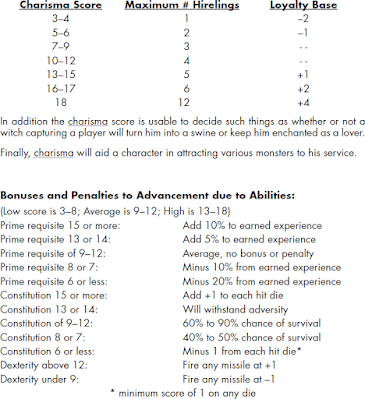
Ability score effects in OD&D

The other scores only mattered in terms of determining bonus or negative XP earned, if one of them happened to be the prime requisite for your class: you could gain up to 10% bonus XP, for example, if you were a Magic User and had an Intelligence of 15+, or lose up to 20% of all earned XP if your prime requisite was 6 or less.  Otherwise Intelligence didn't officially matter one way or the other.

With such comparatively weak effects, what would become the old-school standard of 3D6 to determine attributes worked fine, and there was nothing unusual or especially difficult about playing a character with average or even low ability scores.  From the release of Supplement I: Greyhawk (1975) onward, however, attributes starting granting higher bonuses to more things and being required to access more of the available classes.  In Greyhawk, Strength and Intelligence received non-class dependent effects, to match Dex, Con and Charisma, while the effects of Constitution were increased.  The supplement was also the first to introduce demihuman level limits based on their attributes.  For example, Elves, originally limited to 4th level as Fighters, could now become 5th level if they had Strength 17, and 6th level with an 18.

It's not necessary to detail every change in the old-school rules that increased the importance of ability scores: it's enough to understand that ability score creep started early, culminating in AD&D.  This led to increasingly convoluted rolling methods to “randomly” generate scores while still ensuring high enough values were generated to keep players happy, Unearthed Arcana's infamous Method V being the best example.[12]

But while the above illustrates the steadily increasing importance of ability scores, this only shows how the design intent behind the game shifted in its first decade.  To some degree this sort of progression was natural: if you're going to bother having ability scores, they might as well actually do something in game terms, after all.  Other than inviting stat inflation and an encouragement to cheat during character creation, this evolution didn't really change the fabric of old-school play much.  Where this matters is more in what this set the stage for.

The ability score check, where one tries to roll equal to or under their ability score to succeed at something, was first seen in proto-form in Dragon #1 (1976), in an incredibly convoluted fan article that was promptly ignored forever.  In official terms, the AD&D spells Dig and Phantasmal Killer were the only core points of that ruleset to employ such a mechanic, in one-off fashions: the core manner of resolution for any given task was "figure out if it involved an element of chance, and if so, figure out some odds for it on the spot, applying modifiers as the DM deemed necessary."  Of course, officially this is pretty much the way most every RPG is handled.  The key difference is that most games come with a standard method by which this is done: a core mechanic that handles such situations.  As per the opening of this article, for old-school D&D, there was none.  If it wasn't specifically covered by the rules, you made it up how to resolve it entirely, including the roll (if any) or other resolution method involved in resolving it.  Lest we get too revisionist, rolls still occurred all the time to resolve matters: every DM formed basic assumptions or principles to guide their decision-making process, and this often defaulted to the dice (as suggested by the DMG, p. 110).  The importance here is not in some sort of idea of dice versus no dice, but in the fact that there was no assumption in the rules that dice were required for such resolutions, let alone that everything could or should be resolved that way and that there was further a pre-defined, "proper" way to do so.  This may sound like splitting hairs, but the actual effects in terms of gameplay are enormous.
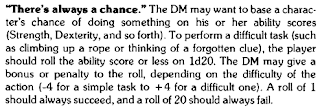
Moldvay Basic, 1981
A system-wide D20 ability check mechanic first appeared in 1981’s Moldvay (p. B60), tucked away in the DM section as an optional method called “There’s Always A Chance”, and in that same year's Cook (p. X51), which featured the same rule but called it "Saving vs. Abilities" and expressly badged it as optional in a way that was only implied by Moldvay.  From the two oddball spell implementations in AD&D mentioned above, the mechanic next began slipping into AD&D support products: first in I3 Pharaoh (1982).  The issue was revisited in Dragon #67 in an article by Katharine Cook (Dec. 1982), which, following the general 1st edition love of percentile checks, multiplied your ability score by 5 to arrive at a percentage chance of accomplishing tasks related to that score.  Even Gygax eventually used a form of it: 1982's WG4 (The Forgotten Temple of Tharizdun) called for a check to dodge a net by rolling 4D6 and trying to get equal to or less than your Dexterity.  The popular Dragonlance modules from DL2 (1984) onward used such checks--called a “Characteristic Check” there--introducing the concept at the start of each volume as a required mechanic.  In 2nd edition AD&D, ability checks were included in core, but like Moldvay in a vague manner: "ability check" appeared in the Player's Handbook glossary and was not mentioned as being optional, but the rules themselves did not employ it beyond this.[13]

Ability score checks are simple, intuitive, and quick: it's no surprise that from such ad-hoc beginnings they grew to become the favoured task resolution method of many groups and then systems.  Third edition made ability checks an unambiguous core rule: anything that was not resolved via skills (which were modified by attributes) was to be handled via ability checks.  Their elegance conceals several dangers, however.  For one, as written above concerning the Survival Guide ability score-based proficiency system, there's little granularity to such checks unless you are very free with modifiers: players with high stats almost always succeed, and players without very often or almost always fail.  Secondly, everything written above about the button-pushing tendency created by skills applies twice as much to the ability score check: whereas a skill is by its very nature bounded to a specific area, even if a broadly applicable one like "Search", the ability score check marks the arrival to D&D of universal task resolution.  Anything could, and eventually was officially required to be, adjudicated using it.  Rather than challenges being solved via the interplay between player and DM, ruled on an ad-hoc basis, the first few rolls a player made during character creation determined much of their success rate at almost any given activity in all the weeks or months of play ahead, and the dice were first and foremost the means by which you mechanically interacted with the world--and now there was a mechanical interaction for almost everything.  The entire core resolution methodology of the game became, in some fashion, button pushing.

Again, while one can argue that the negative gameplay results of such were not intended and are by no means completely necessary, the obvious differences between the play style of old-school D&D versus third edition and later are, I'd argue, no coincidence.  Though the official ability score generation rule for AD&D and its successors largely remained Method I from edition to edition (excepting 2nd and 4th ed, though even in 4th it was one of three available methods), ever-escalating ability scores became the norm, until the very idea of playing with scores that applied negative modifiers was often seen as ridiculous.  More importantly, a clean, fair, consistent, easy to use system wound up smoothing away a kludgy, improvised, inconsistent, occasionally abused, and extremely interesting fundamental element of the old-school playstyle, and the result was that the emphasis on player creativity over what was on one's character sheet swung decidedly the other way.

I am writing in opposition to all of these new nonweapon proficiency rules.  They are boring, damaging to campaign balance, and simply don’t belong in AD&D games.  They are boring in that they slow down play and give players a whole new set of statistics to worry about.  They damage balance in cases such as when a fair-size party covers almost all of the best proficiencies; situations that normally require thought and problem solving are easily taken care of.  For example, in the AD&D module WG4 The Forgotten Temple of Tharizdun, there is a scene in which the PCs are forced to either have a desperate battle in the dark or hold off a demon until they can find the secret of lighting the area.  Thanks to proficiencies, the local barbarian could blind-fight the thing to death, and the party could figure out the lighting at its leisure.  If you want proficiencies, there are plenty of games out there loaded with proficiencies; play them.  The AD&D game is one of DM’s judgment and improvising.

Bahman Rabii, Dragon #137 (September 1988)

Next time I'll be focusing on the broader changes introduced by 2nd edition, to explore how that edition is commonly charged both with being too similar and too different to what had come before.


[1] See, for just one example, Len Lakofka’s article analyzing the new weapon specialization rules: “Specialization and Game Balance”, Dragon #104 (Dec 1985).


[2] “The Transition Starts Now”, Dragon #99 (July 1985).


[3] The first reference to 1.5e I can find is from 1995, in the rec.games.frp.dnd usenet group.


[4] I'm not including the 1st edition DMG's Secondary Skill system here.  This system, which gave a character a pre-adventuring career (e.g. farming, sailor, teamster, hunter, trapper), and a broad knowledge base derived from this, featured no rolls or special abilities.  It was "up to the DM to create and/or adjudicate situations in which these skills are used or useful to the player character."  This system would be featured as an option in 2nd edition as well, alongside the NWP system.


[5] The common OSR approach to secret doors, as epitomized in Matt Finch's influential A Quick Primer, largely follows the AD&D and earlier approach, but as we have seen, it was not the only method used in old-school play and there has been some pushback against Finch's depiction as overly reductive or even anachronistic.  See this Alexandrian article for a 2009 example of such.


[6] Another good example of such includes the D&D/AD&D thief, whose skill-based set of abilities lent itself well to button-based gameplay ("I search for traps"*rolls*).  See also this article on "hidden skills" in B/X, and Grognardia's overview of the thief's role in D&D.  At the same time, for those who find the traditional OSR interrogative approach to be an exercise in pixelbitching, cutting to the chase with a simple mechanical solution can be very freeing.  Similarly, placing the burden of estimating risk vs reward and the mechanical execution thereof on DMs relied on the DM being good at doing that on the fly, and many were not, easily leading to frustrated players and relief at having something codified by professionals (though one look at the procedures in the Survival Guides made it clear that professionals did not always get it right).  Again, we’re largely speaking of how approaches can differ and change, rather than always contrasting right vs. wrong.


[7] Looking back on nonweapon proficiencies in 2008, in a thread on Dragonsfoot Cook wrote, "I think they were a good thing.  One of the things dreadfully lacking from AD&D was any sense that your character had a real life beyond class skills.  This gave players a way to create a more culturally informed background for their character.  Well-used and applied, proficiencies were a way to say things like "This is the result of being raised by farmers/wolves/priests/pirates."  It got people to think about their characters as something other than being sprung fully formed from the forehead of Zeus.  Now proficiencies didn't work as well when they just became excuses to do special things in combat.  At that point they lost the sense of making your character more than a class and became another way to munchkinize him."


[8] As an example, the very first non-OA skill check in D&D—1988's I14 (Swords of the Iron Legion)—appears in a scene where a horse breaks free and runs wild in the streets.  Unless someone has Speak with Animals, only a character with Animal Handling is permitted to deal with it in a fashion besides just killing it.


[9] 3D6 down the line was used in OD&D, Holmes, B/X, BECMI, and AD&D 2nd edition; 1st edition was the outlier in this regard.  Note that several of these had "hopeless character" clauses that allowed you to discard PCs who had very low scores.  I think the popularity of 3D6 down the line in the OSR is one-part the dominance of B/X over AD&D and one part "hardercore than thou" zeal of the converted exhibited by some of the OSR's adherents.


[10] Another issue is the quantum skill check, where a skill check result is delivered regardless of player actions.  For example, “If the party fails the check, an NPC just points the fact out.”  In these cases, pass or fail: the result is the same.  This however just tends to signal a certain pedestrian strain of design rather than actually ruining the adventure.


[11] I also find interesting 2nd edition dev Steve Winter's notion that "The counter argument, which I seldom hear, is that relying on a numerical system to resolve skill use rewards players who are good number maximizers at the expense of those who are not.  By favoring one approach over the other, aren't we just swapping one type of player talent for another?" 


[12] For a statistical analysis of the standard old-school ability score rolling methods, see this Dragonsfoot thread.  Note that its Summary 3 has a couple of minor errors.  For a magic-user using Method 0, the chance is 70.64%, not 74.07%, and for an illusionist using Method 0, the chance is 0.43%, not 1.50%.  Additionally, I think all the Method 3 values are wrong, not that anyone generally uses that method.


[13] According to Daniel Boggs over at Hidden in Shadows, Arneson employed a version of attribute checks in the 70s, though as with so much related to Arneson the details are a bit vague. 

05 February, 2021

A Historical Look at the OSR — Part I

There are a lot of articles about what makes a game OSR and what the Old-School Renaissance is.  Some are quite informative and succeed in boiling essential elements down into digestible morsels; many aren't worth the bytes spent to release them into the electronic wild.  However, even with all the writing on what is and isn't OSR, I still notice plenty of players asking "what is OSR, anyways?"  More importantly, just as many seem to skip the question phase and move right to operating under the premise that the OSR is, well, all sorts of things.

 Common assumptions lately are that it's a label for:

  1. any old game (where "old" is in the eye of the beholder, and as such has reached the impossibly distant 90s in some cases)
  2. any rules-light independently produced fantasy game
Ultimately, for all of the writing on what the OSR is from a gameplay and theoretical perspective, there really isn't much out there that explores it in a cohesive historical fashion.  Being a historian by trade, I figured I'd throw my hat in the ring, trying to arrive at the goal not by arguing in favour of a theoretical conclusion of how the game should be played, but working through what happened and why.  I wasn't paying attention at the OSR's start (I was more interested in BattleTech and Champions at the time, feeling that I had exhausted what old-school D&D could offer and not particularly interested in 3rd edition after the initial thrill had worn off), but "not having been there" is par for the course for most any historian, and with a blog mistakes are easily correctable.  If you have no interest in lengthy historical analysis, skip this series of posts.
 

The Decline of the Old School The Adventure

 
Dungeons & Dragons, in its original 1970s form, was conceptually a relatively straightforward game.  It featured a tight gameplay loop where characters explored dungeons and occasionally the wilderness to acquire wealth, which they then hauled back to civilization to go up in level, so that they could go and explore tougher dungeons and wilderness areas.  Add roleplaying to taste; rinse and repeat.
 
Early on this was enough for most people: just playing this novel new style of game sufficed to entertain.  In the same way that one sits down to a game of Monopoly[1] and doesn't ask about why they're competing for these very select set of properties or why they have to work under capitalist principles, early D&D largely focused on its own obvious gameplay loop.  In short, there wasn't much "what's my character's motivation?"  You play Monopoly because you're there to play Monopoly; most played D&D because it was an interesting game about dungeons and you wanted to go and see if maybe there were dragons in them.[2]  With the DM's connivance and the players' wishes, PCs could be anything they wanted eventually, but the default assumption early on was that they were not heroes (at least, not automatically) but professional graverobbers, seeking to get rich or die trying.  If you wanted more, there was certainly scope for that thanks to the flexibility roleplaying provided, but that was on the local group rather than the system as a whole.
 
As such, early adventure modules gave you settings and situations much more than they gave you deep plots. The Lost City, Keep on the Borderlands, White Plume Mountain, Castle Amber, The Isle of Dread: it's no coincidence that these are places rather than events.  With the assumption that you didn't need to convince people who had showed up to play D&D that they should bother playing D&D, modules simply provided sites to explore rather than hammering you over the head with a plot and accompanying assumption that you needed to be persuaded to go to these places in the first place.  Exploration (and the gold this provided, which allowed you to level up) was its own reward.
 
That having been said, exceptions appeared very early on.  The first official TSR modules were released four years into the game's existence: B1, D1, D2, D3, G1, G2, G3, and S1 all came out in 1978.  S1 (Tomb of Horrors) was an example of the tournament module, an adventure originally designed to be played at a tournament with strict time limits, players the DM didn't know, and in a competitive fashion.  Due to the limitations imposed by such requirements, these modules were often tightly constrained: there was no room for sandbox play, with players instead often unceremoniously dumped at the entrance to the site as the start of the adventure.  Scoring systems were used to decide which party "won" the module.  Like the concept of ante in the Magic card game, the tournament module became a relic that vanished relatively early and is often poorly understood by later players.  Some tournament modules would later be redesigned into more freewheeling efforts for their official public release, but as clear and purposeful deviations from the norm, we can largely ignore modules like S1, the A line (the Slavers series), and the C (Competition) line, all devoted to / rooted in the tournament niche.
 
More notable was the G series (Against the Giants).  Also originally a tournament module series, even in its official release it opens with players being given a clear quest (eliminate the giants) and on pain of death no lesswhat people would come to critique as railroading.  The story of the G series was continued in the D series, where we learn that the drow are the force behind the giants.  As such, the vast majority of the initial module line for D&D was in some fashion plot-based.

At the same time, there's plot and then there's plot: the "story" of the Giants series is a quick framework designed to get play going, an artifact of its tournament origins, and D 1-2 opens with the note that "Unlike the expeditions against the giants, no compulsion is placed upon adventurers to undertake this journey."  The players have a large amount of flexibility in how they accomplish their task, there's no unkillable NPCs, quantum ogres and other events, predetermined resolutions, and so on: to compare it to later efforts because both have a forced impetus and an overall framing arc / villain motivation is to distort things beyond a useful point.

Overall, the official style in this period emphasizes player agency: barring the immediate circumstances of their surroundings, the attitudes and approaches to the test at hand were largely the players' own.  Equally, the environment was generally not adjusted on the fly to better accommodate them or the perceived "needs of the story" (i.e., with the exception of random encounters, an encounter occurred when it occurred, as laid out beforehand: events might change based on the actions of the party—e.g. they sounded an alarm—but they weren't shifted about to better meet the current HP of the party or towards some perceived sense of the dramatic).  It can be a challenging style, in that it demands adventures crafted with that style in mind, DMs willing to improvise, and active players—those used to having their adventures and motivations served up on platters can easily be bored to tears if handed an adventure almost entirely determined by their actions and not armed with an understanding of what is expected of thembut it's an immensely freeing one for those interested and up to the challenge.

This broad style of play supportlocation-based exploration, perhaps with a thin veneer of plot to jumpstart things (e.g. U1 The Sinister Secret of Saltmarsh)predominated until about 1982.  That year had some good releases (B4 The Lost City is a particular gem), but also the first non-tournament TSR module that really broke with the above.  When making a list of the usual suspects credited for ushering in the demise of the old school, X3 (Curse of Xanathon), by Douglas Niles, is not generally featured.  And yet, it's the first clear break in the freewheeling exploratory trend that had predominated to that point.  It opens with a note:

The Curse of Xanathon is an unusual module, in that much of the players’ actions will be in the form of detective work

And indeed, X3 is a mystery module.  Why is the Duke of Rhoona behaving so oddly?  The players must find out.  Of course, mysteries have an annoying habit of not being as easy to work out as the author might think.  Niles is prepared for that, however, and includes this note:

If a group of players is unfamiliar with this type of detective game, they may become frustrated or disinterested.  The DM is encouraged to offer additional clues whenever these would seem to be necessary.  This can be handled in a number of ways.  For example, the High Priest of Forsetta, who moves around in a beggar’s disguise, is introduced in Scenario 1.  The DM should feel free to use this character whenever necessary as a source of information and guidance to the party.

Reviewers of the time noted the conceptual issues: Jim Bambra in issue 48 of White Dwarf called Curse of Xanathon "very much a programmed affair".  Players "move through a series of distinct and logical stages, discovering clues as they go".  He noted that if the players fail to follow the clues, the DM must direct them to the next encounter, which of course cut down on the amount of freedom available.  Similarly, Doug Cowie, in Imagine #3, had some observant commentary.  If the players do things properly, he noted:

they will progress in an orderly fashion through 5 scenarios, puzzling out what is going on and eventually setting things to rights.

Herein lies the problem of this module.  No party of players that I have known ever does what they are supposed to, in the right order, through five different adventures.  To assist in getting the players through the module properly, the DM is provided with Eric of Forsett.  He sounds like a steak & kidney pie manufacturer but is, in fact, a clerical heavy.  He pops up whenever the party is going astray and guides them back on course.  After he has appeared a few times, it is going to look a little obvious and players may feel overmanipulated.  Similarly, the first three scenarios are prompted by Ducal proclamation.  The first time the Duke's Herald comes round shouting his head off is OK but after that players tend to become a little cynical and ignore such an obvious ploy to guide them where the DM wants them to go.

The investigation / mystery itself would always remain a minority of adventures, difficult to pull off at any time and D&D being replete with spells that make a lot of mystery elements unfeasible except with awkward convolutions besides, but overall this was very much a new style of adventure, one that reduced player agency and provided hamfisted direction to better explore a plot rather than an area.  It was a distinct harbinger.

Another notable element in the evolution of module design was the creation of boxed textsegregated blocks of text intended to be read aloud to the players.  The separation of DM text from player-intended information can be seen as early as 1979's T1 (The Village of Hommlet).  However, boxed text proper first appeared in 1980 with A1 (Slave Pits of the Undercity) and C1 (The Hidden Shrine of Tamoachan).[3]  This was a natural development: it's the DM's job to convey information to the players, and a module would logically provide such.  Boxing it helps separate DM and player info, and if written well can provide good atmosphere.  That both of these were tournament modules was likely no coincidence: boxed text also ensures that all competitors get the same core of essential information, helping maintain a level playing field.

The downsides to this innovation became apparent fairly quickly: the practice soon moved from telling the players what they see and hear, to telling the players what they think and feel, and ultimately to telling them what they do or don't do, robbing players of agency as their very actions and emotional states were determined for them and removing much of the question-and-response interaction between player and DM that made up so much of the early exploratory playstyle.  Additionally, boxed text soon became a vehicle for writers to indulge their worst storytelling tendencies, a phenomenon referred to in some quarters as "failed-novelist syndrome".  Paragraphs soon grew to half-columns, full columns, and even page-long and multi-page-long narratives the DM was expected to read aloud and the players were expected to sit passively and absorb, with descriptive colour and essential facts haphazardly mixed together so that players easily missed key detail.[4]

Here's an example from C1, highlighting some of the tendencies that began appearing on day one:

Nine sentences in length, this is already pushing the limits of what players can easily absorb via listening, though it does largely limit itself to useful descriptive room detail.  At the end, the players are presumed to be taking action, whether they want to or not ("upon approaching the other door").  (As an aside, it also seems confused as to whether or not it is describing action ("upon approaching") or potential action ("will come into sight"), likely an artifact of still working the idea out.)  Boxed text in many ways encapsulates the practises that would eventually kill off the old school: a logical outgrowth of existing gameplay, meant to be helpful, at its best capable of being quite useful, but in its most common manifestation detrimental to the playstyle.[5]

1983 was notable in that, with the exception of I6 (Ravenloft), none of the modules released that year are considered classics.  Some of them feature what would become the worst excesses of TSR (and later) module design, though Ravenloft and UK1 (Beyond the Crystal Cave) attempted to do some things differently.  A second generation of designers had arrived at TSR: Michael Malone, Garry Spiegle, Carl Smith, Merle M. Rasmussen, and Bruce Nesmith were writing material in a different mode.  TSR had filled sixty new positions in 1981, and as of August 1982 nearly 40% of its employees had been hired in the previous twelve months.[6]  Meanwhile, by the autumn of 1982 Gygax began stepping back from development duties, as the larger concerns of TSR as a corporation occupied his attention: particularly his presidency of TSR Entertainment, which saw him spend much time in Hollywood chasing after film and animation deals rather than writing or directly supervising module development.

Let's take a look at an early example of what would become typical in post-old-school adventure design.  1983's X4 (Master of the Desert Nomads) was written by David "Zeb" Cook, who had helped create the original Expert (of B/X fame) box set.  Primarily a wilderness exploration module (which the X series was intended to contain), the players are recruited as part of an army to battle a group of increasingly troublesome desert marauders led by "The Master".  However, the players arrive too late to the army's assembly area and must hurry on alone to catch up.  This is a strong framing device that tells the players what's happening and what they're up to, but as we've seen, such a thing isn't really different from several treasured modules released earlier.

More egregious, at least from an old-school perspective,[7] are the fixed, quantum-style encounters and overall assumptions of reduced agency that occur throughout the adventure.  For example, 

Encounters #1 and #2 should occur, in either order, before players reach the swamp: it is suggested that both occur some distance upstream from the village of Pramayama.  Encounter #3 should occur while the characters are crossing the swamp.[8]

The DM is advised that these programmed encounters should be carefully doled out, based not even on where the DM has chosen to place them ahead of time but on the perceived pace and status of the player group:

if several of the player characters are severely hurt, the DM should wait until the characters are almost to the end of the river before having the next encounter, The Watchers on the River.  The DM controls the timing of all the encounters.  He does not have to worry about the characters missing an important encounter by not going in the right direction.
Similarly, there is a later encounter delivered via boxed text based entirely on the premise that the players have agreed to do something, whether they would have wanted to or not:

Not finding the company of the caravan the most pleasant or sociable around, your party has accepted orders from Lamshar to act as an advance guard.

Overall, this is an important mission, the module stresses, and so the players

will discover that their mission has even attracted the attention of higher beings.  Appearing at one point in the module is an "Unknown Benefactor."  There is no explanation of who or what this being is, and the player characters are not able to observe it closely.  The being only appears in the most absolute of need, but it should not be used to bail the characters out of situations into which they have stumbled through their own stupidity or foolishness!  The Unknown Benefactor appears in the module for atmosphere and feeling, not as a cure-all to the characters' problems.
These are important caveats, but caveats or not, the appearance of what amounts to DM-placed training wheels (for characters levels 6-9 no less, ones presumably in the hands of experienced players) is a notable reduction in assumptions of player self-direction and responsibility.  David Cook would go on to be the lead developer of 2nd edition AD&D.

Reviewers were noting these changes, often favourably.  Future TSR employee Rick Swan's review of X4 in Space Gamer #71 commented that it provided "welcome relief from the tedious dungeon exploration all too common in TSR D&D modules".[9]  The release of more and more products like X4, and similar reviewer comments in this period about "the traditional dungeon crawl" and the like, indicated that the idea of just exploring a complex for the sake of exploration was becoming passé.  By this point D&D was approaching ten years old, and people were looking for it to provide something different.

1984's Dragonlance megasaga, the first five modules of which were released that year alongside the first Dragonlance novel (Nov 1984), provided it.  The immortal Dave Langford reviewed the novel Dragons of Autumn Twilight for White Dwarf #65 in his long-running book column, suggesting that it was "inspired by an AD&D campaign full of chunks ripped bleeding from Tolkien" and critiqued the "Deadly predictable questing, with stock D&D characters in familiar encounters."  Modules 1-4 were written before the first novel (which adapted them), a process reversed for the final two books in the initial novel trilogy.  In this new series, we had player characters on a fixed questnot just one to set up the game, like G1, U1, or I3 (Pharaoh), but to drive the entire adventure.  The PCs were heroes from the start, rather than characters that might become heroes if the players behind them were so inclined and managed to achieve that.  The storyto restore the presence of the gods to the world and defeat the forces of eviltakes primacy over anything the players might wish to do otherwise.  The series was notoriously railroaded.  For example, take this encounter from DL2 (Dragons of Flame), which jumps the party with two ancient red dragons so that they can be taken prisoner if they're not performing as expected:

This encounter returns the PCs to their epic path if they stray or dally.  Run the encounter when the party is in open terrain (plains or low mountains) and has no place to hide.

 Or this one, from DL4 (Dragons of Desolation):

No matter from which direction the heroes approach the final encounter, they find themselves heading down a strangely familiar corridor...  If characters try to go in another direction, they encounter parties of Daergar and draconians that fight to either capture them or force them into the final encounter.

In short, the sandbox was closed.  Tracy Hickman, one half of the team that produced the novel (and also Ravenloft), also wrote five modules in the series.[10]  Its approach reflected his long-standing frustration with traditional D&D: around 1978 he had written a proposal for an adventure series to be entitled Nightventure, which had the following explanatory opening:

Some time ago, I found, with mounting frustration, that my so-called "epic dungeon" was rapidly turning into an "eternal dungeon"; one which even I would never discover the bottom of, let alone any player characters.  My evil wizard would never be routed from the tower--not because of the treacherousness of the way--but because of its tediousness.  There had to be a better way.

Presumably not everyone was happy with this new directionin particular, Imagine #26 had coverage of the UK's GamesFair '85, and it was noted that during a Q&A session with some TSR staff several members of the crowd expressed concern "about the Dragonlance modules and the direction that modules seem to be taking."  But the series was a culmination of already existing trends, and since the initial Dragonlance (DL) series eventually ran for 16 modules, presumably sales told besides.

No other module at this point took its plotting to the same extreme as Dragonlance, but from an old-school perspective, very little that comes out after 1982 is worth getting.  Mark Breault, a TSR employee from 1984-1989, saw no evidence of the near-mythical "no playtesting on company time" rule long rumoured to exist at TSR in the post-Gygax period,[11] but did mention that the general pace of development typically made anything but rudimentary playtesting difficult, a marked contrast to the early wave of tournament- and home-campaign-based module releases, which often had extensive vetting through play.  Overall, he painted a rather dire picture as to the overall development process at the twilight of 1st edition.  Rather than self-directed works, developed entirely by gamers for gamers,

Several months before the start of the year ... the entire design department (game designers and editors) would be called into a meeting.  There our manager would hand us all next year's schedule.  On it were all the products that were to be published by TSR over the following year.  Each product (module, hardback, supplement, etc.) would have its name listed, the product line it fell into, its page length, and the month it was to be published.  There would be much laughing over some of the stupid names the execs picked out for products, but altogether it wasn't a jolly process.

This schedule was presented to us as a fait accompli, set by upper management.  I believe it was also vetted by Random House, our publisher, which had a tremendous amount of influence on TSR's schedule and sticking to it (think in terms of how Wal-Mart dictates everything to its suppliers and you'll have some idea).  We could bitch about various products, refuse to work on them, point out stupidities, and so on.  We were able to push back sometimes and get products dropped or shifted around.  But our primary function at that point was to decide which designer and which editor worked on each product.  That was mostly on a volunteer basis.  When it got down to products in lines people didn't like to work on (Buck Rogers, MSH for most people, D&D [by that time a sideshow compared to AD&D], etc.), most of those were farmed out to freelancers as no internal employees wanted them.

Box text from 1987's I11.[12]
Of the later modules, 1986's B10 (Night's Dark Terror) is probably the best of the lot, firmly plotted but a solid classic regardless, with some elements of interest also in UK4 (When a Star Falls), X5 (Temple of Death), and X10 (Red Arrow, Black Shield).  Gygax lost control of TSR in October 1985 and departed in October 1986; most of the original wave of TSR employees either left with him or in the financial and managerial turmoil of the few years leading up to his departure.[13]  The prevalent module style at the close of 1st edition was largely the same as it would be throughout 2nd edition: the plot-heavy quest adventure, with its large amounts of read-aloud boxed text, essential NPCs that always got away or showed up as the plot demanded, events that occurred regardless of what the party did, and a base assumption of heroism ("the players must save X from the nefarious forces of Y!") regardless of the attitudes of the players or their characters.  Roleplaying as its own reward was increasingly emphasized and the dungeoncrawl increasingly seen as an anachronism, a primitive and even somewhat silly artifact of D&D's growth into a more mature modern form.  If your understanding and appreciation of D&D was rooted in freewheeling, sandbox-style play, where player-directed site exploration was both the means and often the end, you were no longer receiving official support.[14]
 
There was a long period of time when action, rather than role playing, was the major focus of gaming, and this was especially true with respect to tournament scenarios at conventions.  Thus, an AD&D® game scenario would typically stress combat with monsters to achieve the goal set before the characters.  Now, the pendulum has swung the other way much emphasis is being placed on how well the player takes on the role of his or her character.  Personification and acting are replacing action of the more direct and forceful type be it sword swinging, spell casting, or anything else.  Before this trend goes too far, it is time to consider what the typical role-playing game is all about.

First, it is important to remember that "role-playing" is a modifier of the noun "game".  We are dealing with a game which is based on role playing, but it is first and foremost a game.  Games are not plays, although role-playing games should have some of the theatre included in their play.  To put undue stress upon mere role-playing places the cart before the horse.  Role playing is a necessary part of the game, but it is by no means the whole of the matter.

— Gary Gygax, Dragon #102 (October 1985)

 
But Gygax, long busy with other details surrounding TSR, was writing at least a couple of years after the pendulum had already swung conclusively towards that style of play.  Additionally, he lost control of the company that very same month and would be gone from it a year later, and the trend would continue.

Though the dates make it clear, it's important to emphasize that all this happens during the lifecycle of 1st edition AD&D, a ruleset with unquestionable old-school bonafides.  As such, it's clear that rules alone do not determine what is old school: if proper mechanics alone could secure an old-school playstyle, the above process I've laid out could never have occurred.  By the time 2nd edition came out in 1989, the old school was already dead: 2nd edition just placed a capstone on the mausoleum.
 
Though I'll continue to examine how modules develop as we move forward, next time I'll be focusing on the evolution of the ruleset.
 

[1] God help you if you actually willingly sit down to play Monopoly.

[2] I want to add an important caveat.  Overall we're talking about how the initial designers of D&D intended it to be played and what the rules and modules published by them were intended to support, rather than making a universal claim as to how DMs outside the initial Lake Geneva TSR circle actually played D&D in this era.  OD&D was so vague and AD&D so baroque that both lent themselves to all sort of alternate interpretations.  Additionally, D&D is attractive to creative minds, and so even with clear rules the first thing a role-playing gamer often does is tinker and modify, throwing out things that don't fit their style.  As such, people immediately took the ruleset in all sorts of different directions (as published lamentations from Gygax et al. in the period demonstrate; addressing this playstyle drift was one of the design impetuses for AD&D), and you could certainly find people who rapidly abandoned the open site exploration style of play in favour of what would become later norms (i.e. heavily plotted heroic questing) even in this early period; after all, the newer wave of TSR designers and their different design style had to come from somewhere.

[3] Dragon #34 (Feb 1980) also has Doomkeep, an adventure by Bryan Blume, featuring numerous text sections that, while not formally boxed off, are written in red ink and intended to be read to the players. 

[4] Back in 2005 two Wizards of the Coast employees conducted field research at GenCon about, amongst other things, the effects of boxed text on players forced to endure it.  The article is worth reading, but the key point was this: "My hypothesis was that boxed text longer than a paragraph probably isn’t worth reading, because players tend to have pretty bad listening comprehension when it comes to boxed text.  Their eyes glaze over pretty quickly.  What I actually saw was much more dramatic than my hypothesis.  If you’re the DM, you get two sentences.  Period.  Beyond that, your players are stacking dice, talking to each other, or staring off into space.  Time after time, players were missing the actual data in the boxed text – basic stuff, like room dimensions, how many doors exit the room, and number of monsters."

[5] Anthony Pryor, author of 1992's WGQ1 (Patriots of Ulek)—a module infamous for its large amounts of boxed text—said of the use of boxed text that "I don't recall it being a hard-and-fast requirement, but since everyone else was doing it, we followed suit.  It was an example of a good practice getting worn out by overuse and becoming a major tool in the 'railroad the players' arsenal."

[6] Per Jon Peterson.

[7] I'm not arguing that the old-school method is the one true way to play D&D, though it's the one I prefer.  It's simply the focus of this article series.  For those fine with more structured modules, X4 can provide a solid play experience, though you really need X5 (Temple of Death) for it to work, since it's not so much a sequel as the other (and better) half of the module.

[8] Not even Gary Gygax was immune to this sort of thing.  1982's S4 (The Lost Caverns of Tsojanth) has a hermit encounter with the advice that "You should place this encounter at a location that is most useful to the players.  Place it near the caverns if they are not doing too well, at some distance if they are highly capable."  There's also his last module for TSR, 1986's WG6 (Isle of the Ape), which has a full two pages of boxed text to open it.

[9] Swan's review of WG5 (Mordenkainen's Fantastic Adventure) in Space Gamer #73 is a much deeper exploration of his thoughts on how tired old-school D&D had become for him, but his review is written with the sense that this feeling is a much wider one.  "As roleplaying becomes more sophisticated, those early days of Dungeons & Dragons seem long ago indeed.  The once-fascinating attraction of assuming the identity of a mighty warrior or magician purely to explore a creature-filled dungeon in search of treasure now seems hopelessly quaint to today's experienced roleplayer.  I'd venture a guess that Gary Gygax's cheerful admission in the preface ... that 'this is what is generally termed a hack-and-slash' module will send many roleplayers running for the hills."  In the same issue, Swan gave a glowing review of DL2 (Dragons of Despair), despite noting that it was "tightly scripted" and "not particularly flexible".

[10] The author of the 2nd, 6th, 9th, and 14th volumes was Douglas Niles, the author of X3.  Niles and Hickman also co-authored the 11th volume, which though given a DL module code like the rest was a wargame module for the series rather than a RPG supplement.

[11] Frank Mentzer stated that TSR simply felt able to publish modules with little to no playtesting after its early days, due to feeling that they had acquired enough experience designing modules to not need it.  "Most of my later RGPA tournaments were never playtested."

[12] Note the caveat: "paraphrase the following ... or intersperse it with questions from the PCs to avoid reading it in one long section."  Future module writers would often skip this sort of warning, even as the amount of boxed text climbed even further.

[13] Per Jim Ward, "In 1984 TSR had 386 employees....  In five ugly purges the company went from 386 people to 86 people."  See also Jon Peterson, here and here, for details on earlier purges.

[14] The close of 1st edition is a little difficult to make categorical statements of with regards to modules, as TSR was performing a lot of experiments at the time.  The original short-adventure anthology and the Battlesystem / War Machine mass-combat module, both relatively short-lived things, flourished at this time.  And then there was the DA (Dave Arneson) line, the DragonQuest crossover, Castle Greyhawk....